

In digital marketing, it’s never been more critical to understand how customers discover, research, and purchase products and services.
With over 80% of purchase decisions starting with an online search, websites must effectively deliver content that people are searching for.
But not all searches are created equal. The way a person searches can mean I’m not sure what I’m looking for, or I’m just looking, or I’m ready to buy. It’s important to understand the connection between search behavior and the buyer’s journey, as it determines everything about how you should approach content creation and optimization.
The Sales Funnel: From Problem to Purchase
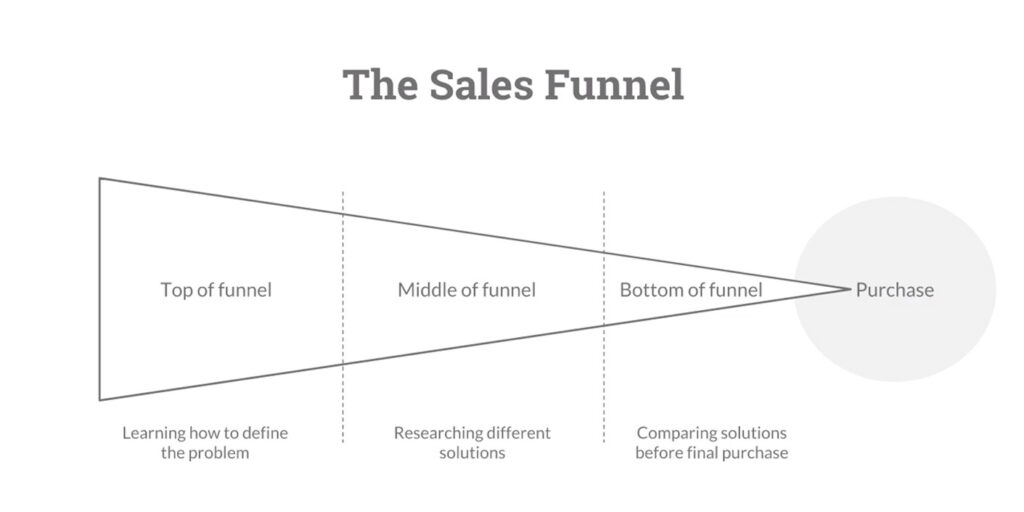
The traditional sales funnel consists of three main stages—top, middle, and bottom—each representing a different stage of the buying journey. Understanding these stages is the foundation of smart SEO strategy.
Top of Funnel: The Solution Seekers
At the top of the funnel, searchers typically don’t know what they need. They’re experiencing a problem and looking for answers, often using broad, question-based queries. These users represent the largest potential audience but also the least purchase-ready segment.
Consider someone dealing with a pest problem. Their search might be: “How to eliminate a carpenter ant infestation.” They’re not shopping for specific products—they’re trying to understand their problem and explore potential solutions. This informational search intent represents an opportunity to educate and build trust with future customers.
An important note: Top-funnel searches are currently getting hammered by Google’s AI Overview. Many people now get the answers they need from the overview, and are not clicking through to websites. Serious buyers may click through to sites cited by the overview, and may peek a little beyond the overview, but it’s harder than ever to pull in audiences at the top of the funnel.

Middle of Funnel: The Researchers
In the middle of the funnel, searchers have identified their problem and are researching specific solutions. They use more technical language and their searches become more targeted and solution-focused.
That same person might now search for “Boric acid ant bait.” They’ve moved from general problem-solving to evaluating specific treatment methods. They’re comparing options, reading reviews, and narrowing down their choices. Competition increases at this stage as searchers begin considering specific product categories.
Bottom of Funnel: The Buyers
At the bottom of the funnel, intent becomes transactional. Searchers know exactly what they want and are ready to purchase. They search for specific brands, products, or local suppliers. This is where brand names finally come into play, and where competition reaches its peak.
Our ant problem solver might now search “Terro ant killer”—a specific brand and product they’re ready to buy. These bottom-funnel searches have the highest conversion potential but also face the most competition from established brands and retailers.
Why This Matters for SEO Success
Aligning your content with your visitor’s buying journey can transform your search performance, as competition, search behavior, and even Google’s algorithms change dramatically at each funnel stage.
Top-of-funnel searches offer the largest audiences with less brand competition, but those audiences aren’t ready to buy, and the AI Overview is killing visibility. Bottom-of-funnel searches face competition from established brands, but they deliver higher conversion rates by motivated buyers.
By creating content that matches user intent at each stage, you can guide potential customers through their entire journey.
Ready to Get Started?
Here at Stride, our expert team can help guide your content creation to enhance SEO and capture users at each critical stage of their buying journey. We can work with existing content—or start from scratch—to optimize your content and start getting results. Contact us to learn more.